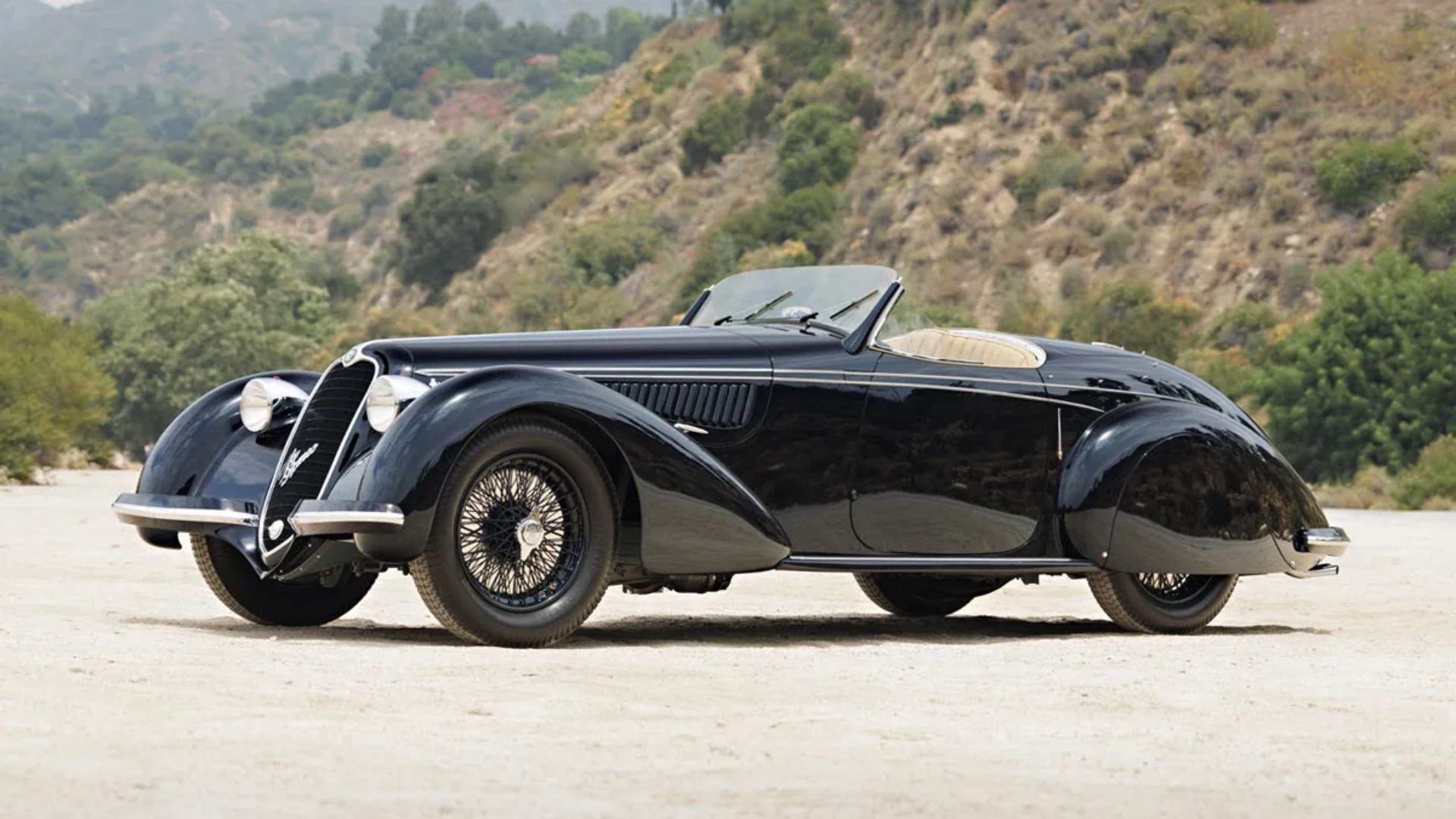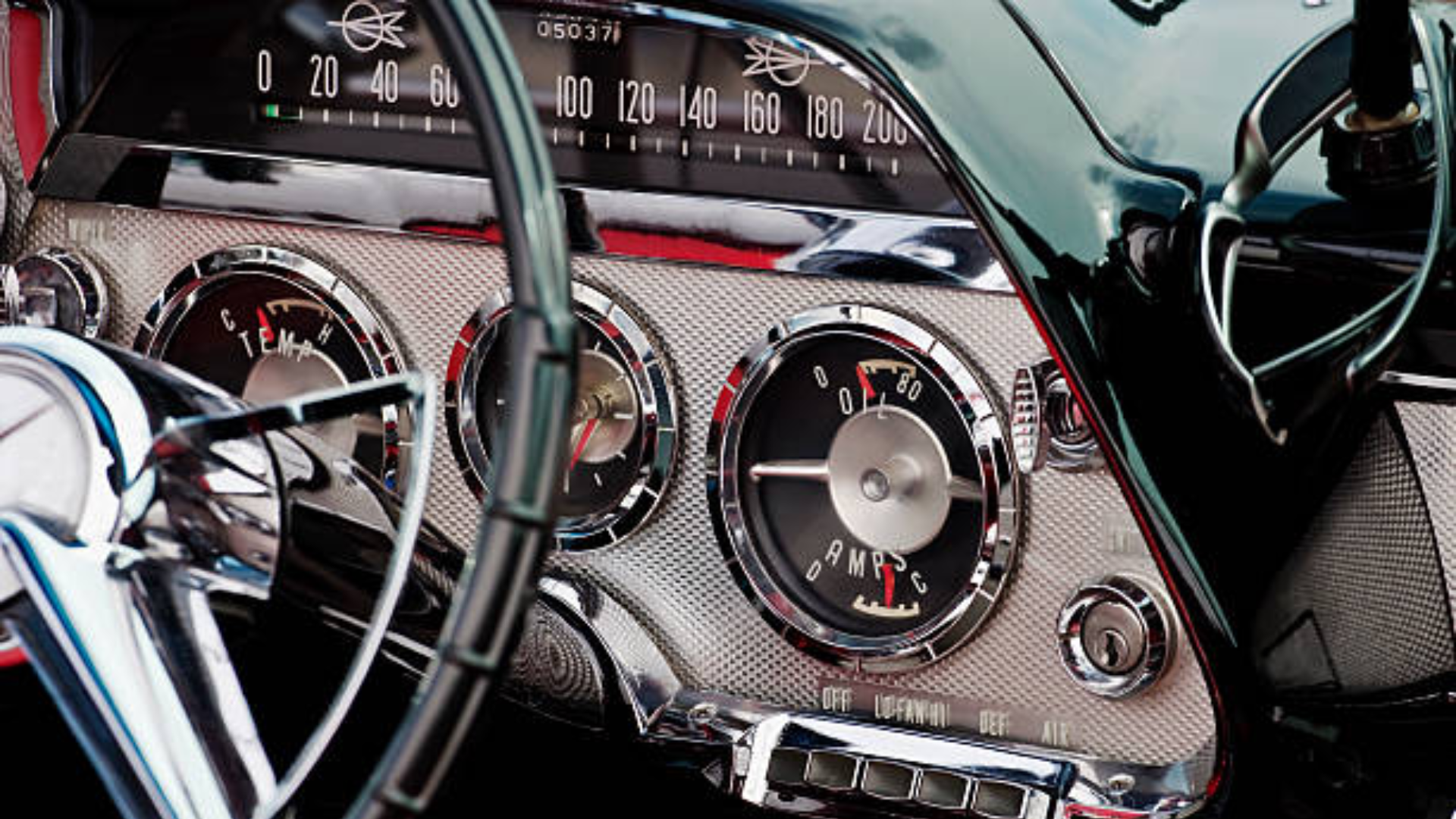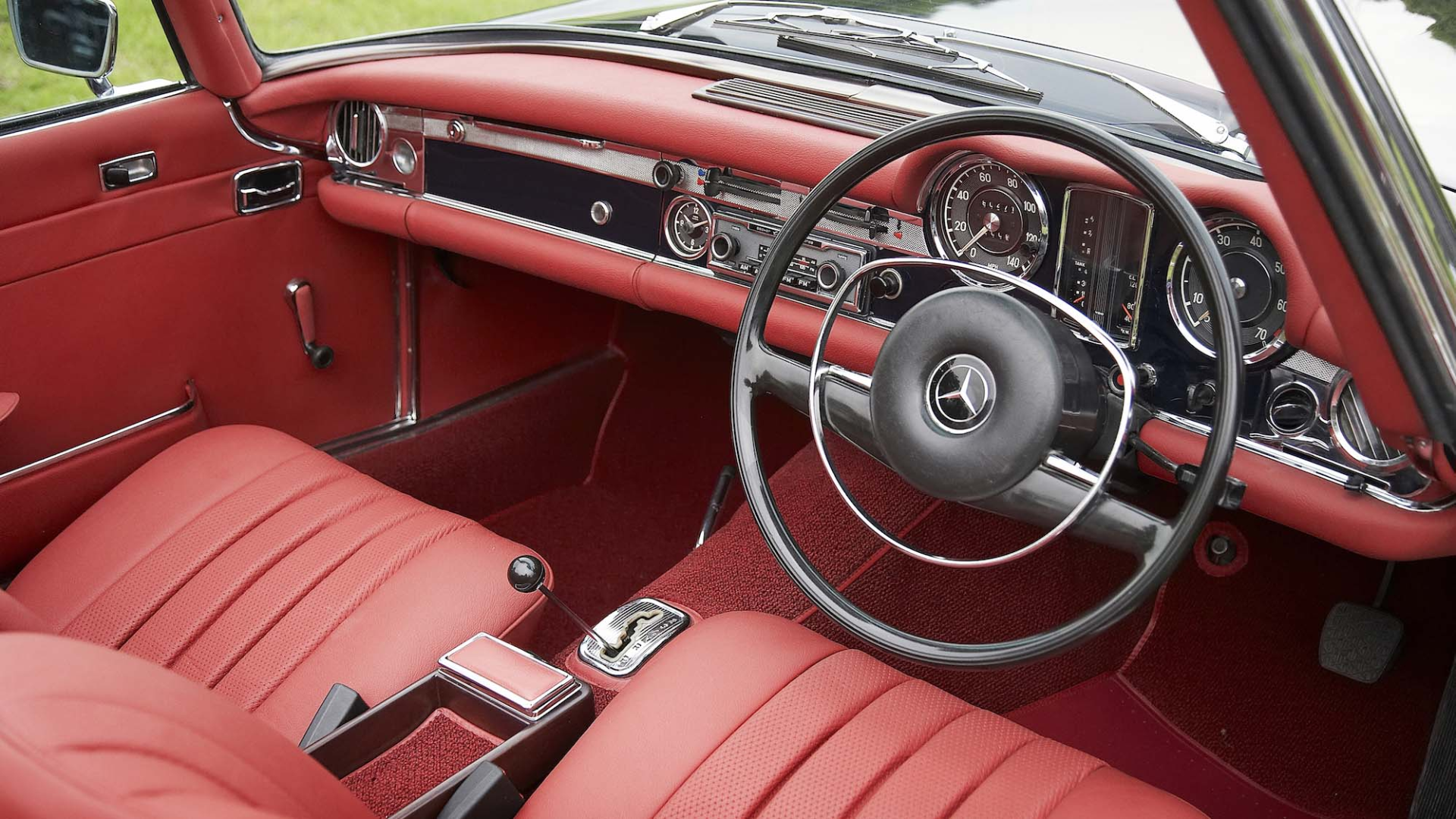
The dashboard, the dials, the wood, the smell of oil-cured leather. Why the cabin of a pre-1975 motor car is one of the great underrated achievements of twentieth-century design.
Step into the cabin of a properly preserved 1965 Aston Martin DB5, close the door — that satisfying, dense thunk unique to mid-century coachbuilt automobiles — and pause for a moment before turning the key.
What you are sitting in is not a car interior. It is a small, beautifully made room: walnut burr, hand-stitched Bridge of Weir leather, Wilton wool carpets, instruments by Smiths of Cricklewood whose faces have not changed in design since 1948. Every visible surface was, at the time of manufacture, made by hand, by a person whose name was very likely known to the person who fitted it.
The era
The years between roughly 1955 and 1973 represent the high-water mark of the analogue automotive cabin. The marques of the period — Aston Martin, Rolls-Royce, Mercedes-Benz, Jaguar, Ferrari, Maserati, Bristol, Bentley — operated within a shared aesthetic consensus that valued tactility above all else.
The dashboard of a 1968 Ferrari 365 GT 2+2 is, simply, the work of a watchmaker. Each instrument is bezelled in chrome, set into walnut, and lit from within by a single low-wattage bulb whose glow, after dark, is closer to that of a candle than of an electric light.
This was not nostalgia. This was current practice. The men who designed these cabins had never seen a digital display, had no expectation that one was coming, and were working at the absolute peak of what mechanical instrumentation could achieve.
The smell
A correctly preserved analogue interior smells specific. Connolly leather, after thirty or forty years, develops a scent that is part library, part well-kept saddlery, part the faint sweetness of horsehair-padded seat bases. Add to this the trace of lacquered walnut, the cold-mineral note of properly oiled steel, and — present in the best examples — the faintest top-note of light machine oil from the heater linkages.
It is, frankly, one of the great smells in human manufacturing. It cannot be reproduced. It cannot be retrofitted. It is the byproduct of correct materials, correctly aged.
The instruments
Consider, for a moment, the rev counter of a 1972 Jaguar E-Type Series 3. The face is matte black. The numerals are silver, applied by hand. The needle — a single piece of red-lacquered aluminium, perhaps half a millimetre thick — is balanced so precisely that it remains absolutely still at idle and yet responds to a touch of the throttle with the immediacy of a violin string.
This needle is connected, mechanically, to a cable, which runs to the engine, which moves the needle. There is no electronics. There is no software. There is no firmware update. The instrument has worked, continuously, since 1972, and will continue to work, with minimal attention, for as long as anyone bothers to keep the cable greased.
There is something profound in this.
The argument for preservation
The conventional restoration approach to a fifty-year-old interior — strip everything, fit modern leather hides, refinish the wood to a mirror gloss — produces an interior that looks correct in photographs but feels, when you sit in it, subtly wrong. The leather is too uniform, the wood too polished, the dials too crisp. It looks like a film set. It does not look like a life.
The better approach is patience: clean what is original, repair what cannot be saved, replace only what is unsalvageable, and accept — even celebrate — the small marks that fifty years of use have left. A faint patina on the steering rim where a previous owner's hands rested. A slight darkening of the leather above the gearlever. A small crack in the walnut, beautifully filled with a sympathetic resin.
These are not flaws. They are the point.
What we have lost
The modern automotive cabin — even the high-end version of it — is a screen-and-haptic exercise. The instruments are simulated. The dials are pixels. The wood, if present, is veneered to perfection over moulded plastic. The smell is showroom-new, and disappears within eighteen months.
None of this is bad, exactly. It is simply different. It is optimised for a different set of values: information density, software updateability, ease of mass production. Fine values. But not the values that produced the cabin of a DB5.
The cabin of a DB5 was optimised for one thing: the pleasure of the person sitting in it, alone, at half past six on a winter morning, fingers warming around the steering rim, watching the rev counter rise as the engine cleared its throat.
That is what we are preserving. Not the car. The moment the car was built to produce.