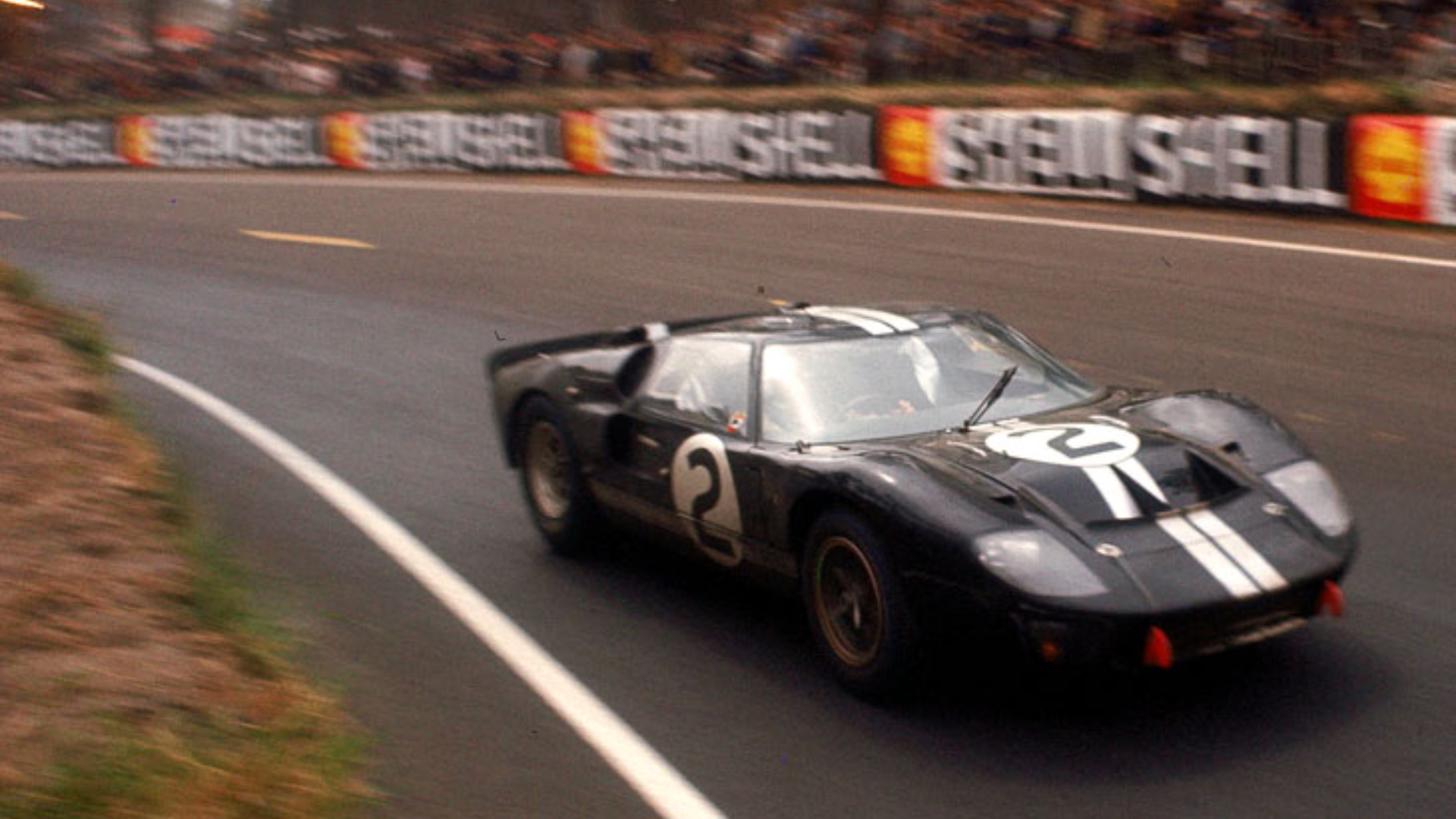
The story of Ford versus Ferrari has been told. The story of the men inside the cars — exhausted, terrified, magnificent — remains the more interesting one.
By the time the chequered flag fell at four o'clock on the afternoon of Sunday, the 19th of June 1966, three Ford GT40 Mark IIs had crossed the line in formation, and the racing world had quietly turned a corner whose significance would only be understood in retrospect.
The official story
The headlines wrote themselves. Henry Ford II had vowed, four years earlier, to humiliate Enzo Ferrari at his own game. He had spent — by some estimates — twenty-five million dollars, the equivalent of perhaps two hundred and forty million in today's money, to achieve it. And he had.
Ferrari's works team had retired all three of its cars by the morning of the second day. The little Italian scuderia — which had won the previous six runnings of the race outright — went home empty-handed.
The story behind the story
But the more interesting narrative was never about the marques. It was about the drivers — twelve men in three Fords, eight men in three Ferraris, each one operating at the absolute outer edge of human concentration for twenty-four consecutive hours, in machinery that, by modern standards, was hopelessly fragile and not particularly safe.
The 1966 cars had no seatbelts of consequence. The roll cages were optimistic. The fuel tanks sat directly behind the driver's shoulder blades. To race a GT40 at Le Mans in 1966 was to take, with full eyes, a meaningful chance with your life.
Bruce McLaren and Chris Amon, who would win, hadn't slept properly for forty-eight hours by the time they reached the podium. Ken Miles, who should have won — who had led the race on merit, who had driven faster, more consistently, more bravely than any other man on the circuit — was instructed by team management, in the closing minutes, to slow down. To allow a photo finish. To share the victory.
He did. And he lost it, on a technicality of distance covered, to McLaren. He would be dead within two months, killed testing the next generation of the same car.
What Le Mans actually was
Twenty-four hours, in 1966, was a different proposition than it is today. The cars had no telemetry. Pit communication was limited to a board held over the wall once a lap. Tyre compounds were essentially one. Fuel stops were carried out without refuelling rigs, by men with simple churns, in seconds you would not believe.
A driver entered the cockpit at four in the afternoon on Saturday. He emerged — if he was lucky — at four on Sunday. In between, he was alone with the engine, the road, the dark, and the slow arithmetic of his own endurance.
A small moment
Late on Saturday night — perhaps midnight, perhaps a little after — Phil Hill, an American who had won the race twice for Ferrari in the early sixties and who had walked over to the Ford pit garage that year as an unofficial observer, was standing in the rain near the start-finish line.
He watched the leading GT40 come past at the head of the long Mulsanne straight, its headlamps cutting the wet air. He stood for a long moment, hands in the pockets of his coat. Then he turned to a young journalist beside him and said, simply: "This used to belong to us."
He did not mean Ferrari. He meant the thing itself — the night, the noise, the impossible competence — and he was right. By 1966 it belonged to no one, or to everyone, and the men who drove that race did so in the last summer when a great racing driver could still be, fundamentally, a man with a wheel in his hands and very little else.